

Your Supplier Got Breached. Are You Liable? POPIA Third-Party Data Sharing in SA
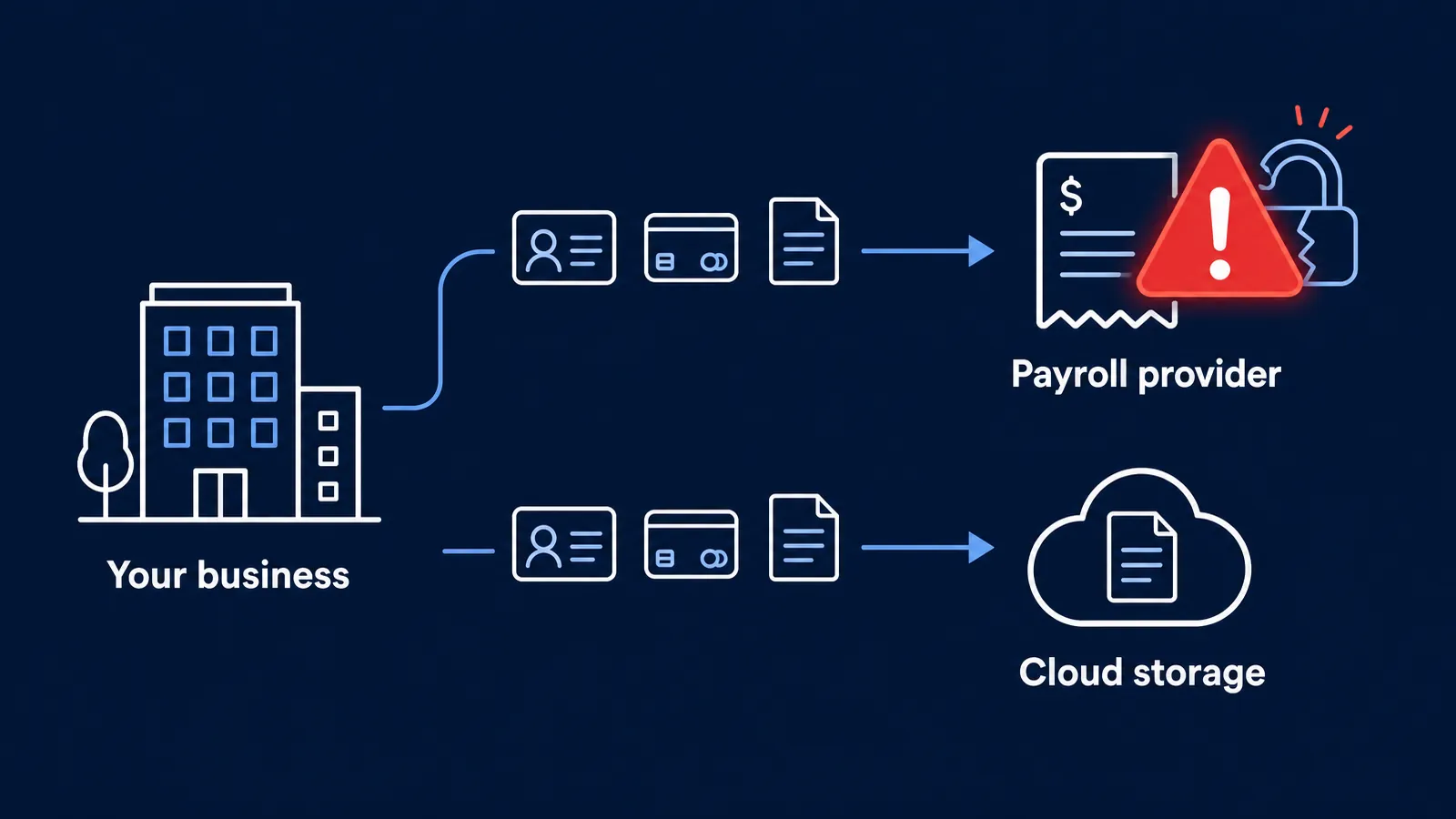
Imagine this. You run a 40-person logistics company in Johannesburg. Every month, your payroll provider processes the names, ID numbers, bank details, and salaries of every employee on your staff.
One Tuesday morning, you get a call — your payroll provider has been hacked. Customer data has leaked. And then, three days later, you get a letter from the Information Regulator asking why you haven’t notified your affected employees.
You didn’t get hacked. Your supplier did. But under POPIA third-party data sharing rules, that distinction matters far less than most South African business owners realise.
This is not a hypothetical risk. Real SA companies have already faced enforcement action, regulatory orders, and reputational damage because a supplier — not the business itself — was the weak link. Here’s what you need to know.
What POPIA Third-Party Data Sharing Rules Actually Say
Under the Protection of Personal Information Act, the relationship between a business and its suppliers is governed by two specific roles. Your business — the one that decides why personal information is collected and how it’s used — is called the responsible party. The supplier who handles that data on your behalf — your payroll provider, your cloud storage vendor, your HR software platform, your bulk email tool — is called the operator.
The critical point: when you hand personal information to an operator, your legal obligations don’t transfer with it. POPIA’s Accountability condition — Condition 1 of the Act’s eight conditions for lawful processing — makes clear that the responsible party remains accountable for that data, regardless of where it sits or who is touching it.
This is where many SME owners get caught off guard. They assume that signing up with a reputable payroll company, a well-known cloud provider, or a big HR software platform means the compliance burden moves to that supplier.
It doesn’t. If their systems are breached and your customers’ or employees’ data leaks, the Information Regulator will come looking at you.
The Scenario SA SMEs Should Know Cold
Bongi’s Logistics: A Realistic Example
Let’s go back to that logistics company.
Bongi’s Transport Services uses a third-party payroll platform to run salaries for 40 employees. The platform stores employee names, ID numbers, home addresses, and banking details. Bongi didn’t negotiate a written data processing agreement when she signed up — it was quick, the platform looked professional, and the monthly fee was reasonable.
In July, the payroll platform suffers a credential-stuffing attack — hackers used usernames and passwords leaked from another breach to force their way in. The platform notifies Bongi a week later. By this point, employee data may have already been circulating online.
Bongi now has three problems. First, she must notify the Information Regulator as soon as reasonably possible — this is a legal requirement under Section 22 of POPIA.
Second, she must notify every affected employee individually, in writing, with enough information for them to protect themselves. Third, because she had no written operator agreement in place, she has compounded a compliance failure on top of the original breach.
The Information Regulator can now investigate not just the breach itself, but whether Bongi took reasonable steps to protect that data in the first place — including whether she had a proper contract with her payroll provider. Under POPIA, not having that written agreement is itself a contravention of the Act, even if no breach had ever occurred.
The Written Contract Requirement in POPIA Third-Party Data Sharing
Section 21 of POPIA requires every business sharing personal information with a supplier to have a written operator agreement in place. This is not a best practice. It is a legal requirement.
The Dis-Chem case from 2023 made this explicit.
Dis-Chem’s third-party e-statement provider, Grapevine, suffered a brute-force attack that exposed approximately 3.6 million customer records — names, email addresses, and cellphone numbers. The Information Regulator’s enforcement notice against Dis-Chem found three core failures: no written operator agreement with Grapevine, a failure to ensure Grapevine had adequate security measures, and a failure to properly notify affected data subjects. Dis-Chem — not Grapevine — faced the enforcement action.
The written agreement must require the operator to establish and maintain the same security safeguards that POPIA requires of the responsible party itself under Section 19 — appropriate, reasonable technical and organisational measures to protect personal information. It must also require the operator to notify you immediately if they have any reason to believe a breach has occurred, so that you can then fulfil your own notification obligations.
A proper POPIA operator agreement covers the scope of processing, security requirements, confidentiality obligations, breach notification timelines, audit rights, data return or destruction on contract end, restrictions on sub-contractors, and cross-border data transfer controls. If you’re sharing personal information with any supplier right now and don’t have this in place, you’re already non-compliant — even if everything else is in order. An operator agreement template can give you a starting point, but it should be reviewed against your specific supplier relationships.
What Happens When Things Go Wrong — Real Penalties
POPIA’s enforcement mechanisms are real, and the Information Regulator has demonstrated it is willing to use them. For South African business owners, there are three layers of exposure when a POPIA third-party data sharing failure occurs.
Administrative Fines
The Regulator can issue administrative fines of up to R10 million per infringement notice under Section 109 of POPIA — without a court order. Confirmed fines to date include R100,000 against Lancet Laboratories for failing to notify, R500,000 against Blouberg Municipality, and R5 million against the Department of Justice for ignoring an enforcement notice.
Civil Claims from Affected Individuals
Under Section 99 of POPIA, any individual whose personal information was exposed can sue your business directly — and they don’t have to prove you were negligent. Courts can award damages for financial loss, emotional harm, and legal costs, in any amount deemed just and equitable. Critically, if a POPIA claim is settled after action has been instituted, the settlement must be made a court order and published in the Government Gazette — so you cannot quietly resolve these claims.
The Total Cost Dwarfs the Fine
IBM’s 2025 Cost of a Data Breach Report found the average cost of a data breach in South Africa is R44.1 million — with detection and escalation alone accounting for R17.5 million. For breaches caused specifically by third-party or supply chain compromise (which accounted for 17% of all SA incidents in 2025), the average cost was R29.6 million.
That is more than the R10 million POPIA fine cap — without a single rand in regulatory penalties being counted. The business disruption, customer notification, reputation management, and potential litigation costs add up fast, even for a 30-person SME.
Breach notifications to the Information Regulator are also rising sharply. The Regulator received 3,219 reported breaches between April 2025 and March 2026, with 1,858 linked to financial services alone. These are not anonymous statistics — behind each one is a business that had to send notification letters to its customers, explain itself to the Regulator, and manage the fallout internally.

Five Steps Every SME Should Take on POPIA Third-Party Data Sharing
You don’t need a legal team or a compliance department to get this right. But you do need to take deliberate action — because the gap between being exposed and being protected comes down to a few specific steps.
Map every supplier that touches personal information. This includes your payroll provider, cloud storage, HR software, email marketing tools, IT support company, accounting software, and bulk SMS platforms. If they handle names, ID numbers, banking details, contact information, or health data belonging to your employees or customers, they are an operator under POPIA.
Get written operator agreements in place. If you share personal data with a supplier and there is no written contract governing how they handle it, fix that immediately. The agreement must require them to meet Section 19 security standards, notify you immediately of any breach, and restrict their use of the data to your instructions only.
Vet your suppliers’ security posture. Signing a contract is not enough if the supplier has no meaningful security in place.
Ask what security controls they use, whether they hold ISO 27001 certification or equivalent, and how they handle a breach internally. A supplier’s security gap is your liability.
Know your Section 22 obligations. If a breach happens — whether in your systems or your supplier’s — you must notify the Information Regulator and affected individuals as soon as reasonably possible.
The clock starts on discovery, not when the supplier gets around to telling you. The Regulator’s Form SCN1 (Security Compromise Notification) is submitted via their eServices portal, and your business’s Information Officer is responsible for completing it.
Review your exposure across all active supplier relationships annually. POPIA compliance is not a once-off exercise.
Suppliers change, your data-sharing arrangements evolve, and new tools get added to the stack. A regular review — at least once a year — keeps your operator agreements current and your exposure visible.
Where a Managed IT Partner Fits Into This Picture
Most of the SME owners we speak to aren’t across POPIA third-party data sharing rules in any depth. They know POPIA exists. They know it has something to do with how you handle customer data.
But the operator liability chain — the way your payroll provider’s security gap becomes your legal problem — is genuinely not widely understood.
A managed IT partner isn’t a substitute for legal advice, but they do fill a critical gap: the technical side of what a written agreement requires. When Section 21 says your operator must maintain Section 19 security standards — appropriate technical and organisational measures — someone needs to assess whether your supplier actually meets that standard. That’s an IT question, not a legal one.
When your cloud vendor suffers a breach, someone needs to verify what data was exposed, contain the damage quickly, and document what happened for your Regulator notification. When you sign up with a new SaaS platform that will process employee or customer data, someone needs to evaluate its security controls before you share anything. These are the kinds of gaps that a managed IT partner — one that understands both the technical threat landscape and the compliance obligations that come with it — is positioned to address.
What This Means for Your Business
POPIA third-party data sharing liability is one of those areas where businesses discover their exposure only after something goes wrong. By the time a supplier breach lands in your inbox, the question of whether you had a written agreement, whether you vetted their security, and whether you have a notification plan ready — all of that is already answered. You either did the work or you didn’t.
The Dis-Chem case is not a story about a big company making a big mistake. It is a story about the routine act of sharing customer data with a service provider — something every business does — and what happens when the compliance obligations around that act are not taken seriously.
The Information Regulator has made clear it will enforce these rules. The question is whether your business is ready.
Is Your Business Covered?
If you’re not sure which of your suppliers qualify as POPIA operators, whether your current agreements meet Section 21’s requirements, or what your notification obligations look like in practice, Wired IT can help. Our IT Strategy, Audit & Consultancy service includes a review of your vendor relationships and data-sharing exposure — giving you a clear picture of where the gaps are before the Regulator finds them first.
Ready to get clarity on your compliance posture? Get in touch with the Wired IT team — we’ll help you work through it.