
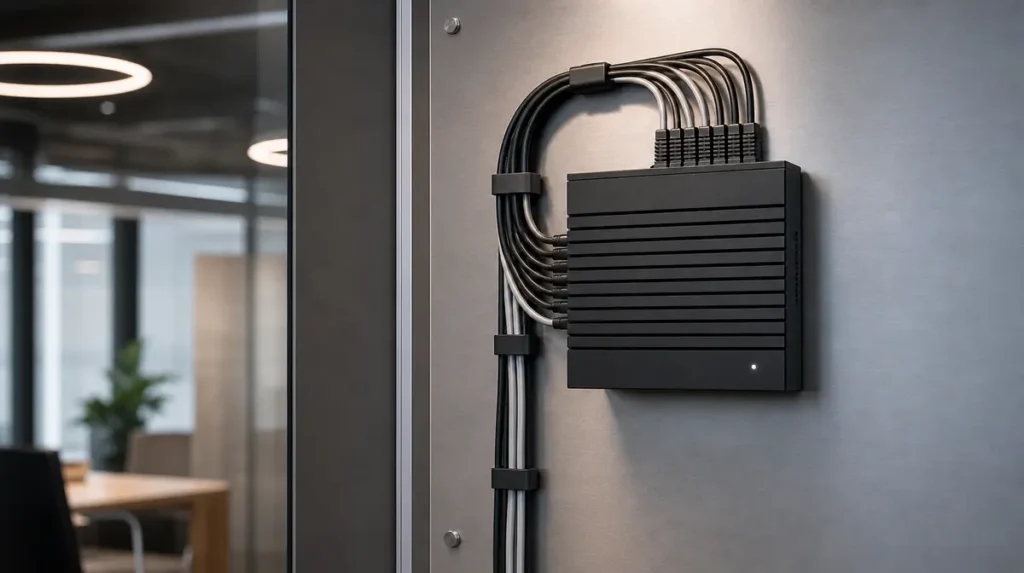
Network Infrastructure and Connectivity
Network infrastructure, South Africa — resilient office and multi-site networks built for load-shedding, fibre and LTE failover, and secure remote access, designed and supported by South African engineers.
Network infrastructure is the layer that lets every other piece of business technology actually function — without it, your servers can't talk to your users, your cloud apps can't reach your office, and your phones, printers, and security cameras fall off the network.
For South African businesses, network infrastructure has to absorb stresses other markets don't face: fibre cuts, exchange faults, load-shedding-driven equipment damage, and the connectivity quality variance between Sandton and a Mpumalanga site.
A well-designed network is the difference between a remote-work day that's productive and one that's lost to "the internet is slow".
Wired IT designs, deploys, and manages networks specifically for South African operating conditions — fibre-primary with LTE failover, segmented Wi-Fi with proper VLAN design, and centralised monitoring that catches problems before users do.
A secure, stable network is the backbone of modern business. We design and manage high performance networks that scale across offices, branches, warehouses, and remote teams.
What Wired IT's Network Services Cover
1. Network Design and Implementation
We design networks that match how your business actually operates today — and how it'll operate two years from now. Not a generic best-practice template.
- Wi-Fi design with site surveys for warehouses, multi-floor offices, and outdoor coverage
- VLAN segmentation for users, IoT, payment terminals, and guest access
- Wired backbone (Cat6 / Cat6A) with documented patching
- Firewall and edge security design (Fortinet, Palo Alto, Ubiquiti)
- IPv4 and IPv6 addressing plan
- Documentation that someone else could actually follow
Where IoT sensors, connected devices, or industrial monitoring hardware are part of the network scope, we coordinate with our IoT and smart system integration service so the underlying network and the IoT deployment are designed together.
2. Secure Connectivity: Fibre, LTE, and SD-WAN
Connectivity isn't a commodity in South Africa — fibre to your office can be Vumatel, Openserve, MetroFibre, or several others, each with different SLA, support, and failover characteristics. We choose, contract, and integrate.
- Fibre supplier selection and contracting
- LTE failover for fibre-down scenarios (essential, not optional)
- SD-WAN integration for multi-site businesses
- Site-to-site VPN between branches
- Dedicated IP ranges where needed for whitelisting
3. VPN and Remote Workforce Connectivity
Remote work in South Africa runs on reliable VPN that doesn't drop, doesn't throttle, and doesn't get bypassed by impatient users.
- Always-on VPN with split tunnelling
- Zero Trust Network Access (ZTNA) for higher-security environments
- Conditional access tied to identity (Azure AD, Okta, Google Workspace)
- Per-user and per-device access logging
4. Real-Time Network Health Monitoring
We monitor every switch, access point, firewall, and link in your network 24/7 through N-Able RMM. We see degradation before users complain.
- Up/down monitoring with SLA alerting
- Bandwidth utilisation tracking by site and segment
- Wi-Fi client health monitoring
- Firewall log monitoring for security events
- Monthly network health reports
5. Load-Shedding-Resilient Network Design
This is the section international templates skip. South African business networks need explicit load-shedding planning: UPS capacity for network gear, generator coordination, prioritised power for the LTE failover path, and reduced-power "essential systems only" modes.
- UPS sizing for network gear (modems, switches, APs, firewalls)
- Generator coordination with automatic transfer switches
- Power-priority planning for failover connectivity paths
- After-hours and weekend remote support during outages
How a Wired IT Network Engagement Runs
Every engagement follows the same five phases — the timeline scales with the size of your environment and the number of sites. We agree realistic dates with you during scoping.
- Network design review. Site survey, current-state assessment, traffic analysis.
- Design. Wi-Fi heatmaps, VLAN plan, failover architecture, equipment list.
- Implementation. Procurement, installation, configuration, cutover.
- Verification. Throughput and coverage testing, failover testing.
- Ongoing monitoring. 24/7 RMM, structured health reports, scheduled review.




Measurable Outcomes
- High-speed, secure connectivity across head office, branches, warehouses, and remote teams
- Fast failover from fibre to LTE during connectivity outages
- Reduced after-hours network incidents through proactive monitoring and load-shedding-aware design
- Documented network architecture so any qualified engineer can take it on if your incumbent IT changes
- POPIA-aligned network segmentation separating payment, guest, and corporate traffic
- Predictable connectivity spend with one accountable provider for switches, Wi-Fi, fibre, and LTE
Frequently Asked Questions
What is network infrastructure?
Network infrastructure is the physical and virtual equipment — routers, switches, firewalls, Wi-Fi access points, fibre and LTE links, and the configuration that ties them together — that allows your business systems and users to communicate with each other and with the internet.
For a South African business, network infrastructure also has to include load-shedding-resilience design (UPS, generator coordination) and failover connectivity that international templates rarely cover.
What's the difference between fibre, LTE, and SD-WAN?
Fibre is your primary connectivity — fast, low-latency, but vulnerable to physical cuts and exchange faults. LTE is wireless connectivity from mobile networks (MTN, Vodacom, Cell C), used as failover when fibre drops or as primary in locations where fibre isn't viable.
SD-WAN is software that intelligently routes traffic across multiple links (fibre + LTE + sometimes microwave) based on application requirements, giving better resilience than any single connection alone.
Do we really need LTE failover if we have fibre?
In South Africa, yes. Fibre supplier outages happen — sometimes for hours, occasionally for days when cable is stolen or an exchange fault is severe.
For any business that loses money during downtime (which is most businesses), LTE failover is one of the highest-ROI infrastructure decisions you can make. Modern routers can fail over to LTE in under 30 seconds.
How is network design for an SA office different from a US or UK office?
Three differences matter most: load-shedding (which means UPS sizing for network gear and generator coordination is part of the design), connectivity reliability (fibre + LTE failover is standard, not optional), and physical security (cable theft and equipment theft are real risks that influence where switches are mounted and how cabinets are locked).
Skipping any of these gives you a network that looks great on paper and fails in production.
Can you support both Ubiquiti UniFi and Palo Alto / Fortinet environments?
Yes. UniFi is excellent value for SMEs with straightforward security requirements; Palo Alto and Fortinet are more appropriate for environments with regulatory or higher-risk requirements.
We design and manage both, and we'll recommend the right fit for your environment rather than pushing one platform.
How does network monitoring actually work?
We deploy lightweight monitoring agents into your network gear (or use the device's built-in monitoring) and aggregate them into N-Able RMM.
The system alerts our 24/7 monitoring team when something deviates from baseline — a link drops, bandwidth saturates, an access point reboots unexpectedly. We act on the alert without you needing to log a ticket.