
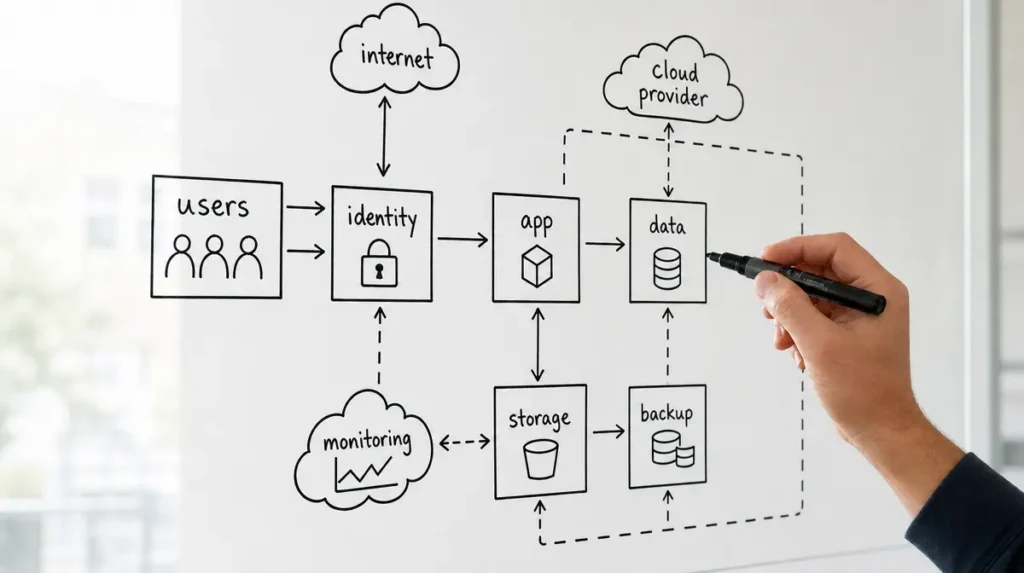
Cloud Solutions and Consulting for South African Businesses
Cloud solutions, South Africa — Microsoft 365, Azure and AWS delivered with POPIA-aligned data sovereignty, local support, and migration planned around South African connectivity realities.
Cloud solutions are computing services — storage, processing power, applications, networks, and security — that you consume on demand from a provider rather than running on hardware in your own office.
For South African businesses, the cloud has become the practical default for new workloads since load-shedding made on-premises servers increasingly fragile and POPIA made the controls around customer data more demanding than most internal setups can sustain.
The South African cloud market spans three layers: Software as a Service (SaaS) like Microsoft 365 and Google Workspace; Platform as a Service (PaaS) like Microsoft Azure App Service for building applications; and Infrastructure as a Service (IaaS) like Azure VMs and AWS EC2 for running virtual servers.
Most businesses use a mix of all three plus selected private or hybrid cloud workloads — and the value of a cloud consultant is helping you choose which workload belongs where.
Cloud should reduce complexity, not create new problems.
Wired IT helps businesses move to the cloud safely and efficiently, building hybrid or cloud-first environments across Microsoft 365, Azure, and AWS — with explicit attention to data sovereignty, POPIA compliance, and resilience against South Africa's specific operational realities.
What Wired IT's Cloud Services Cover
We work across the three cloud models most South African businesses adopt, plus the hybrid and private deployments that bridge them.
Microsoft 365 and Google Workspace (SaaS)
The productivity layer most SA businesses start with — email, document collaboration, video meetings, identity, and basic backup. We handle tenant setup, identity migration from on-premises Active Directory, security hardening, conditional access policies, and end-user enablement.
- Tenant provisioning and licence rightsizing
- Mailbox and OneDrive migration from on-premises Exchange / file servers
- MFA enforcement and conditional access policies
- Microsoft 365 Backup (third-party, because Microsoft's native retention isn't a backup)
- End-user onboarding and adoption support
Microsoft Azure and AWS (IaaS)
For workloads that need their own servers — line-of-business applications, custom databases, file shares — we deploy and manage virtual infrastructure in Azure or AWS. Choice of provider is driven by your workload, not our preferences.
- Azure Virtual Machines, App Services, SQL Database
- AWS EC2, RDS, S3, VPC
- Hybrid Active Directory and identity federation
- Network connectivity (Site-to-Site VPN, ExpressRoute, Direct Connect)
- Backup and disaster recovery across regions
For workloads that need to reach your office network as well as the cloud, we design Network Infrastructure that keeps both environments performant and secure.
Hybrid and Private Cloud
Not every workload should live in public cloud. We design hybrid environments that keep regulated or latency-sensitive workloads close, while shifting the rest to the public cloud where it's cheaper and more resilient.
- On-premises virtualisation (Hyper-V, VMware) with cloud failover
- Private cloud for workloads with data residency constraints
- Cross-environment identity and access management
- Workload placement assessments based on cost, performance, and compliance
Cloud Migration
Most cloud projects are migrations, not greenfield builds. Whatever the size of the environment, the project pattern is the same: assess, design, pilot, cut over, optimise.
- Workload inventory and dependency mapping
- Target architecture design with cost modelling
- Pilot migration with rollback plan
- Staged production cutover
- Post-migration cost optimisation (right-sizing, reserved instances)
Cloud Backup, Replication, and Failover
A cloud workload still needs backup — Microsoft and AWS don't back up your data for you in the way most buyers assume. We add a managed backup layer with documented retention, tested restores, and off-cloud copies for ransomware resilience.
- Veeam, Acronis, or native cloud-vendor backup
- Microsoft 365 backup (mailbox, OneDrive, SharePoint, Teams)
- Off-region replication for ransomware containment
- Quarterly restore testing with documented evidence



How a Wired IT Cloud Project Runs
Every cloud project follows the same five phases — the pace varies with workload count, data volumes, and what you ask us to lead on. We agree realistic dates with you during scoping.
- Assess. Workload inventory, dependency mapping, cost modelling, and a written readiness report.
- Design. Target architecture, identity model, network design, and a phased migration plan.
- Pilot. A small group migrates first to prove the process and surface issues.
- Production cutover. Staged migration of remaining users and workloads, with rollback safeguards.
- Optimise (ongoing). Right-sizing, reserved instances, cost monitoring, and scheduled review.
Why Cloud Solutions Make Sense for South African Businesses
The economics of running your own servers have shifted in South Africa over the last few years. Three local realities have made the cloud calculation more favourable than it once was:
- Load-shedding fragility. Even with a UPS and a generator, every Stage 4–6 day eats into hardware lifespan, increases hardware-failure incidents, and adds operational risk. Cloud-hosted workloads run in data centres engineered for the kind of resilience an SME office cannot replicate.
- POPIA and data sovereignty maturity. Both Microsoft (Azure South Africa regions in Johannesburg and Cape Town) and AWS (Africa Cape Town region) now host customer data inside South Africa, which removes the historical "your data is in Europe" objection to public cloud.
- Specialist skills scarcity. The senior systems engineers needed to run on-premises infrastructure safely are scarce and expensive locally. Cloud removes the dependency on a single specialist; managed cloud removes the dependency on having one at all.
That doesn't mean every workload belongs in the cloud — legacy line-of-business apps with high data egress or latency-sensitive operations sometimes don't pencil out. Our role as cloud consultants is to make that call workload by workload, not blanket-recommend everything goes up.
Measurable Outcomes
Cloud projects done well produce specific, visible business outcomes. Here's what our clients typically see from a Wired IT cloud engagement:
- Reduction in IT hardware spend as on-premises servers age out and aren't replaced
- Resilience to load-shedding outages for the workloads that previously went down with the office UPS
- Documented POPIA-aligned backup and retention for customer data, ready for an Information Regulator inquiry
- Secure remote work for the whole team without VPN bottlenecks
- Predictable monthly cloud costs with reserved-instance optimisation and licence rightsizing
- One operational provider for cloud, security, and helpdesk — not a different vendor for each layer
Frequently Asked Questions
What are cloud solutions?
Cloud solutions are computing services — storage, processing power, applications, identity, networks, and security — that you consume from a provider over the internet rather than running on your own hardware.
The three main models are Software as a Service (Microsoft 365, Google Workspace), Platform as a Service (Azure App Service, AWS App Runner) and Infrastructure as a Service (Azure VMs, AWS EC2). Most South African businesses use a mix of all three.
Is the cloud safe and compliant under POPIA?
Yes — when configured correctly. Both Microsoft and AWS now host customer data inside South African data centres (Johannesburg and Cape Town), which addresses the data residency objection.
Beyond that, POPIA compliance depends on how you configure access control, encryption, retention, and breach detection — which is what cloud consulting and managed cloud services are for. A cloud workload is not automatically POPIA-compliant; it has to be designed to be.
Should we move everything to the cloud at once?
No. We recommend a staged migration: start with the SaaS layer (Microsoft 365 / Google Workspace), then move file and backup workloads, then look at line-of-business applications.
Workloads with high data egress, tight latency requirements, or specialised hardware dependencies sometimes belong on-premises permanently — that's the hybrid model.
What's the difference between Microsoft 365 and Azure?
Microsoft 365 is a SaaS bundle of productivity apps (Outlook, Word, Excel, Teams, SharePoint, OneDrive). Azure is an IaaS / PaaS platform on which you run your own virtual servers, databases, web apps, and other infrastructure.
Most businesses use both: M365 for productivity, Azure for line-of-business workloads. A cloud consultant helps you decide what belongs where.
How much does cloud migration cost for a South African SME?
It depends on what's being migrated — workload count, data volumes, identity complexity, and the number of integrations all affect scope. A Microsoft 365 mailbox migration is a different size of project to an Azure IaaS workload migration, and both look different at SME scale versus a multi-site business.
We provide a fixed-price quote after a cloud readiness review so the cost is transparent before you commit.
Do you support AWS as well as Microsoft Azure?
Yes. We work across Microsoft 365, Azure, and AWS. The right platform depends on your workload, your existing tools and skills, and where your data needs to live. We'll advise on the fit during the readiness review.