
IoT and Smart System Integration for Businesses in South Africa
IoT integration, South Africa — fire, pump and environmental sensors deployed on remote and hard-to-reach sites, with MQTT data capture, automated alerting, and dashboards that work on the connectivity South African operations actually have.
IoT integration is the practice of connecting physical sensors, controllers, and machines to centralised software so that what happens on a site — pump pressure, temperature, fire-alarm state, energy consumption, machine uptime — becomes data your team can see, alert on, and act on in real time.
For South African businesses, IoT integration has direct operational payoff: faster response to outages, automated reporting that used to require manual inspections, and reduced site visits to remote facilities.
The technical layers are well-understood — sensors talking to gateway boards, gateway boards forwarding data via MQTT to a cloud dashboard — but the deployment is where most IoT projects stall.
Choosing the right sensor for the environment, sizing connectivity for spotty rural coverage, and integrating the dashboards into existing operations are the steps that determine whether IoT actually changes how a business runs or becomes another piece of unused infrastructure.
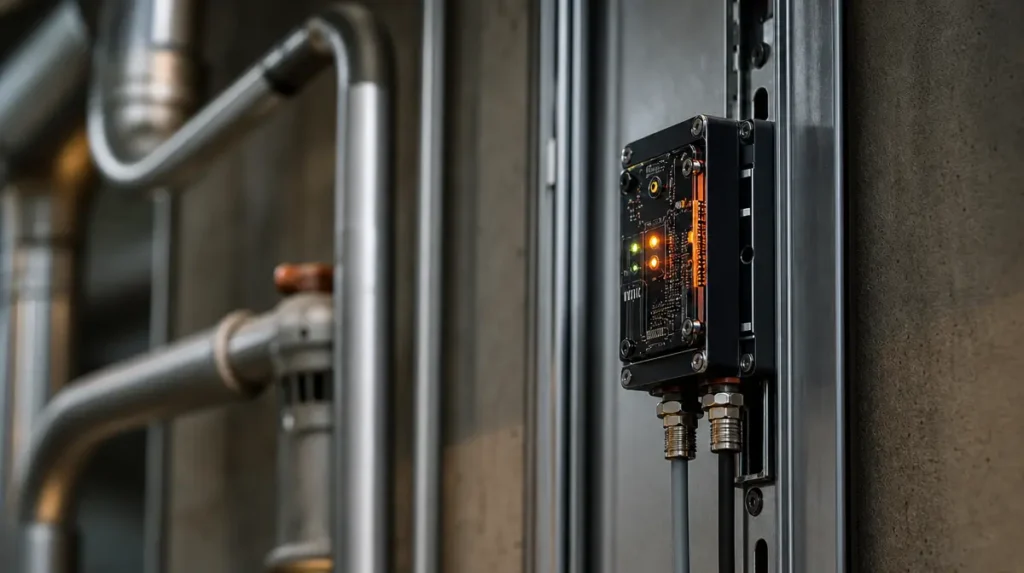
Wired IT enables intelligent monitoring of fire, pump, and environmental systems using IoT technology via our Securlogic partnership. The RS2000 and RS1000 boards provide real-time site data and automated alerts for faster response and improved reliability.
What Wired IT's IoT Integration Service Covers
1. Sensor Deployment via Securlogic Partnership
Through our Securlogic partnership we deploy industrial-grade IoT hardware engineered for South African operating conditions — extreme temperatures, dusty environments, unreliable power, and intermittent connectivity.
- RS2000 board — full-featured gateway for sites requiring multiple sensor types
- RS1000 board — compact gateway for single-purpose deployments
- Fire detection sensors (smoke, temperature, flame)
- Pump and motor monitoring (vibration, current draw, runtime)
- Environmental sensors (temperature, humidity, water leak, door contact)
- Power monitoring (UPS state, generator runtime, mains presence)
Our Securlogic Partnership
Wired IT's IoT service is built on a technology partnership with Securlogic — the RS2000 and RS1000 gateway boards, the MQTT data pipeline, and the ManagerX dashboard behind everything we deploy all come through this partnership.
That means one integrated stack rather than a piecemeal combination of independent products: the hardware, the data protocol, the alerting, and the dashboard are designed to work together, supported through one point of contact.
2. MQTT-Based Data Capture and Analytics
The IoT data layer uses MQTT — the open protocol that virtually every modern IoT platform uses — so your data isn't locked into proprietary tooling and can integrate with downstream systems.
- MQTT broker deployment (cloud or on-site)
- Per-site dashboards via ManagerX
- Historical data retention with trend analysis
- API access for integration with existing operations software
- Optional integration with ERP, CMMS, or BMS platforms
3. Automated Alerting and Reporting
What turns IoT from "interesting data" into "operational improvement" is the alert layer. We tune alerts to your operational thresholds so the SMS / email at 3am is one that actually matters.
- SMS and email alerts on configurable thresholds
- Escalation paths (first contact → standby → site visit)
- Scheduled reports (daily site summary, monthly trend report)
- Integration with helpdesk for ticket creation on critical events
- Post-incident dashboards for root-cause analysis
4. Connectivity for Remote Sites
Most IoT projects in South Africa involve sites with no permanent fibre — farms, depots, water-treatment sites, remote pumping stations. We size and supply LTE / 4G connectivity tuned to data volume and reliability requirements.
- LTE failover gateways with multi-SIM redundancy
- Low-power options for solar-powered remote sites
- Bandwidth optimisation for cost-sensitive deployments
- Site-survey support for cellular coverage validation
5. Site Commissioning and Ongoing Support
We don't drop equipment and disappear. Sites are commissioned with documented test results, and we provide ongoing support for the deployed estate.
- Site survey and sensor placement design
- Commissioning with documented baseline readings
- Remote firmware management and updates
- Sensor calibration on schedule
- After-hours support for critical site alerts
Where IoT Integration Pays Off in South African Operations
The right IoT deployment delivers measurable operational return. Common use cases we deploy include:
- Remote site monitoring — water-treatment plants, telecoms cabinets, pumping stations, remote farms where a site visit costs hundreds of rand in time and fuel
- Cold chain assurance — pharmaceutical, agricultural, and food logistics where temperature excursion triggers product loss and compliance exposure
- Fire and life-safety monitoring — early-warning systems for warehouses, agricultural buildings, and high-value asset storage
- Power and generator monitoring — UPS state, generator runtime, fuel levels, and mains presence for load-shedding-exposed sites
- Pump and motor health — predictive maintenance for industrial pumps, irrigation systems, and HVAC plant where unplanned downtime is expensive
- Energy consumption monitoring — sub-metering for tenant billing, energy cost allocation, or sustainability reporting
How a Wired IT IoT Deployment Runs
Every deployment follows the same six phases — the timeline scales with the number of sites, the variety of sensors, and connectivity complexity. We agree realistic dates with you during scoping.
- Site survey and use-case design.
- Hardware and sensor selection.
- Procurement and pre-configuration.
- Site installation and commissioning.
- Dashboard tuning and alert threshold setup.
- Ongoing remote monitoring and firmware management.
Measurable Outcomes
- Faster response to site events — minutes instead of hours when remote sites fail
- Reduced site visits — typically 30–60% reduction in routine inspection trips after deployment
- Documented compliance evidence — temperature logs, fire-safety event records, audit-ready data
- Lower unplanned downtime — early detection of pump, motor, and power issues before they cause outages
- Single dashboard view across multiple sites — operations leadership sees the whole estate at a glance
- Integration into existing tooling rather than another standalone system to log into
Frequently Asked Questions
What is IoT integration?
IoT (Internet of Things) integration is the practice of connecting physical devices — sensors, gateways, controllers — to centralised software so that operational data (temperature, pressure, power state, motion) becomes visible and actionable in real time.
For most South African business deployments it includes hardware selection, connectivity, gateway boards, MQTT-based data capture, dashboards, and alerting workflows.
How is IoT different from a normal alarm system or telemetry system?
Traditional alarm systems are typically closed, single-purpose, and vendor-locked. IoT is open: the same sensor data can feed your operations dashboard, your maintenance system, your billing system, and your compliance reporting — because the data layer is standardised (MQTT, REST APIs).
That flexibility is what makes IoT a multiplier instead of just another system.
What's the typical deployment timeline?
Deployment timeline depends on sensor count and variety, site count, connectivity, and whether custom sensor design is needed. A single-site pilot moves faster than a multi-site rollout, and standard deployments move faster than ones with custom sensor work.
We'll quote a realistic timeline with the design.
Does IoT work on remote sites without fibre?
Yes. Most South African IoT deployments use LTE / 4G as primary connectivity — sometimes with multi-SIM redundancy across MTN, Vodacom, and Cell C for sites where any single network is unreliable.
Data volumes from IoT sensors are typically small (kilobytes per minute), so cellular is well-suited.
Can the IoT data integrate with our existing ERP or maintenance system?
Yes. We use MQTT for the device layer and standard REST APIs for downstream integration. Common integrations include CMMS (computerised maintenance management) for automatic ticket creation on threshold breaches, ERP for cost allocation, and BMS (building management systems) for facility integration.
Is the deployed IoT estate POPIA-compliant?
If the IoT data includes personal information — for example, occupancy data, biometric access control, or fleet driver behaviour — POPIA applies and we design retention, access control, and breach response accordingly.
For purely operational data (pump pressure, temperature, fire detection), POPIA is largely not engaged, but we still document the data flow.