

Your POPIA HR Data Is Leaking — And Most SA Businesses Don’t Know It
Most South African business owners assume POPIA is about their customer database. They’ve updated their website privacy policy, they’ve stopped sending unsolicited marketing emails, and they’ve ticked the compliance box. What they haven’t looked at is the folder on the shared drive labelled HR.
That folder — full of payslips, leave records, performance reviews, disciplinary files, and medical certificates — contains some of the most sensitive POPIA HR data your business holds. And for most SMEs, it is almost entirely unmanaged.
The Information Regulator has been saying this for years. The organisations that have faced enforcement action, fines, and court orders are not all large corporates with sophisticated data teams. Blouberg Local Municipality paid a court-confirmed fine for mishandling a former employee’s personal information.
The Central Johannesburg TVET College received an enforcement notice in May 2026 that included a failure to register its Information Officer — a free, 30-minute task. The gap between what POPIA requires and what most SA employers are actually doing is wide, and it is getting more expensive to ignore.
This article covers the specific HR data categories that carry the most risk, the five most common compliance failures we see in SA businesses, and what the Information Regulator’s escalating enforcement posture means for your business right now.
What POPIA Actually Says About Your POPIA HR Data
Under POPIA, your business is a “responsible party” — legally accountable for every piece of personal information it holds about employees. That accountability begins the moment a CV arrives in your recruitment inbox and continues for five years after the employment relationship ends. It covers job applicants, current staff, former employees, and dismissed staff.
It also covers the personal information of contractors and service providers who work with your business.
POPIA defines “processing” broadly. It is not just what you do with data — it includes how you collect it, store it, share it, and ultimately destroy it. That means a payslip emailed as an unencrypted attachment is a processing event.
An employment contract sitting in a shared Google Drive folder is a processing event. A disciplinary record discussed in a WhatsApp group is a processing event. Each of these is governed by the Act’s eight conditions for lawful processing — and each represents a potential compliance gap.
Three of those eight conditions produce most of the violations we see in SA businesses. Section 13 (purpose specification) says that data collected for one purpose cannot be repurposed without a fresh lawful basis — so payroll data cannot be forwarded to a wellness vendor without explicit consent.
Section 19 (security safeguards) requires appropriate technical and organisational measures to protect personal information — this is where most SMEs fail. Section 21 (operator obligations) requires a written contract with every third party that processes employee data on your behalf, from your payroll bureau to your HR software platform.
The HR Data Categories That Carry the Most Risk
Ordinary Personal Information
Every piece of data in a standard employee file constitutes personal information under POPIA and must be handled in compliance with all eight conditions. This includes full names and ID numbers, home addresses and personal contact details, bank account and tax information (IRP5s), employment history and remuneration details, performance appraisals and 360-degree reviews, disciplinary records and CCMA case files, leave balances and sick leave history, and training records and qualifications.
None of this is unusual HR information — it is what every employer in South Africa collects as a matter of course. The problem is not the data itself. The problem is that most businesses collect it without a documented lawful basis, store it without access controls, share it more widely than necessary, and hold onto it indefinitely without a retention schedule.
Special Personal Information — the Higher-Risk Tier
POPIA’s Section 26 creates a higher protection tier for categories that carry elevated risk of discrimination or harm. Health information — medical certificates, sick leave records, occupational health assessments, disability documentation — cannot be processed without a documented lawful basis under Section 27, must be physically and digitally separated from general HR files, and requires restricted access on a need-to-know basis. Biometric data such as fingerprint or facial recognition attendance systems requires explicit written consent from each employee before activation.
Racial and ethnic origin data, trade union membership, and criminal background check results all carry additional restrictions on how they can be used and shared.
Many South African businesses collect special personal information without realising that it requires a different — and higher — standard of care. A sick leave certificate filed in the same folder as a general HR file, accessible to the finance team and line managers, is a named compliance deficiency under the new health information regulations. And as of 6 March 2026, those regulations came into force with no transitional period.
The March 2026 Health Information Regulations: No Grace Period
On 6 March 2026, the Information Regulator published regulations governing the processing of health information under POPIA (Government Gazette No. 54268, GN 7198). These regulations took immediate effect.
Employers are one of eight categories of responsible parties to which the regulations apply — and if you hold sick leave certificates, occupational health assessments, disability documentation, fitness-for-duty reports, or pre-employment medical results, you are already subject to them.
The regulations formalise obligations that technically existed under the general POPIA framework but were often interpreted loosely in practice.
Each category of health data processing must now be mapped to a documented lawful basis under Sections 27 and 32 — a general HR policy does not constitute a lawful basis. Physical health records require locked, secure storage with restricted access. Electronic health records require encryption and access controls. Health data must be separated from general personnel records, not filed alongside payslips and employment contracts in a shared folder.
And if you use an occupational health provider, you need a formal written operator agreement with them.
The cross-border transfer point is worth flagging specifically for any business using cloud-based HR or wellness platforms. If those platforms store data on servers outside South Africa, you must satisfy POPIA Section 72 requirements for cross-border data transfer. Many cloud-based HR tools do exactly this, and most SA employers using them have not checked whether their data processing agreements meet the standard.
The Five POPIA HR Data Mistakes SA Businesses Are Making Right Now
1. No Written Agreement with the Payroll Provider
Many South African SMEs outsource payroll to a bookkeeper, an accountant, or a cloud-based payroll bureau. The provider holds some of the most sensitive personal information in the business: ID numbers, banking details, salaries, medical aid deductions, union contributions, IRP5s. Under POPIA Section 21, this provider is an “Operator.” The relationship must be governed by a written contract that requires the operator to keep data confidential, implement security measures, process only on instruction, and notify the employer immediately of any security compromise.
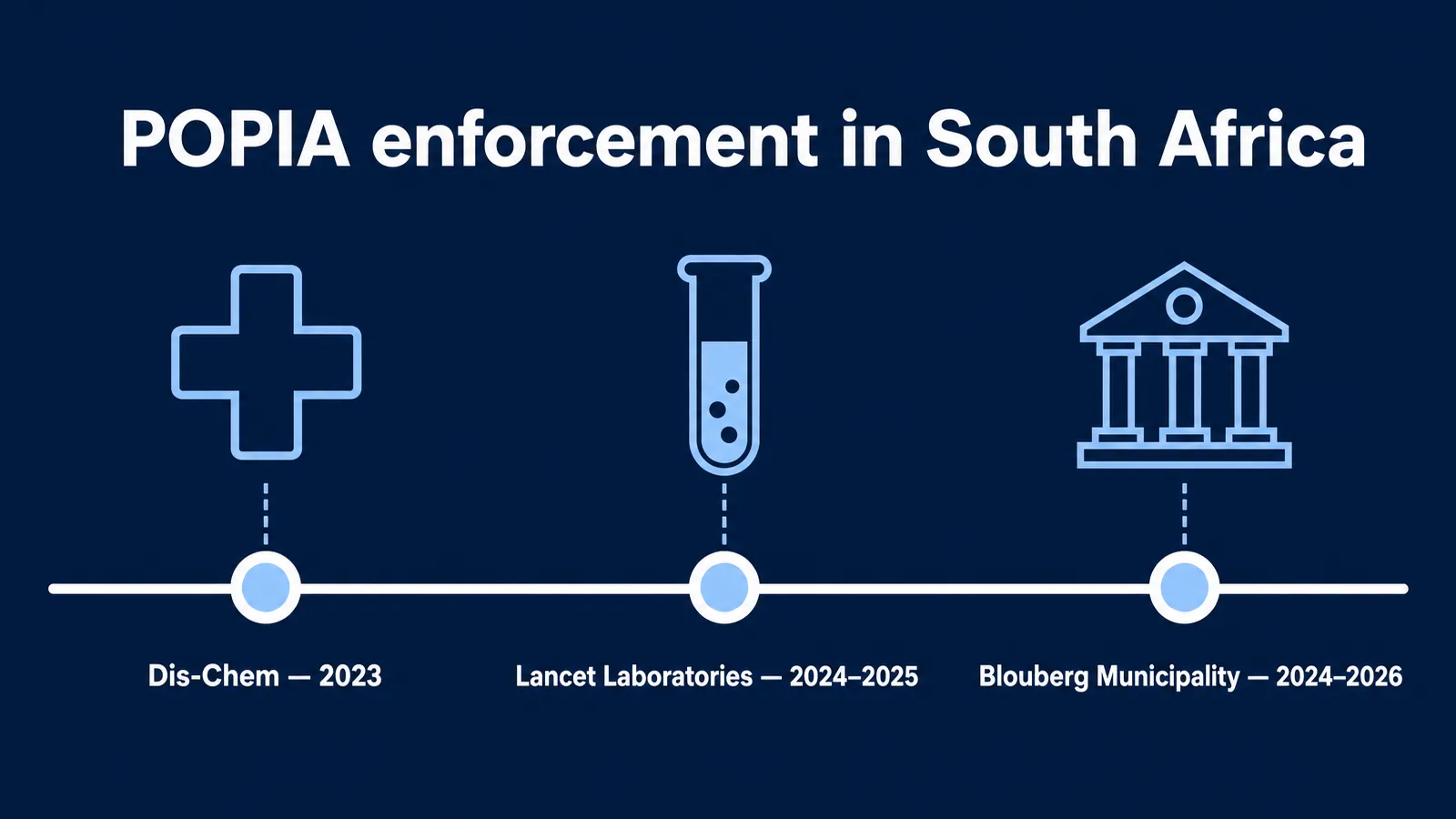
This is not theoretical paperwork. The Dis-Chem enforcement action in 2023 centred directly on the absence of a written operator contract with its service provider Grapevine. A breach exposed approximately 3.6 million data subjects’ records, and the enforcement notice identified the missing operator agreement as central to the finding.
Dis-Chem complied and paid no fine — but every SA employer outsourcing payroll without a written agreement is in the same position Dis-Chem was before that breach. The obligation extends to every vendor with access to employee data: HR software platforms, benefits administrators, background screening companies, occupational health providers, and cloud storage services.
2. Payslips and HR Files Stored Where Anyone Can Access Them
Most SME employers store employee POPIA HR data across multiple disconnected systems simultaneously: a payroll platform, a leave spreadsheet, an HR document folder shared over email, physical filing cabinets, and possibly a third-party payroll bureau holding its own copy. Each of these creates independent compliance risk.
Email attachments have no access control, no audit trail, and no retention management. Shared drives without role-based access control mean that your bookkeeper, receptionist, and line managers may all have access to payslips and banking details they have no business reason to see. Spreadsheets create version drift, have no access log, and can be copied and pasted without any trace.
A business cannot demonstrate Section 19 security safeguards if its employee IRP5 documents are sitting in a shared Google Drive folder accessible to anyone with the link. The fragmentation problem runs deeper than tidiness — it is a structural compliance failure that most businesses discover only when they do a proper records inventory for the first time.
3. WhatsApp: The POPIA HR Data Leak Most Businesses Don’t See Coming
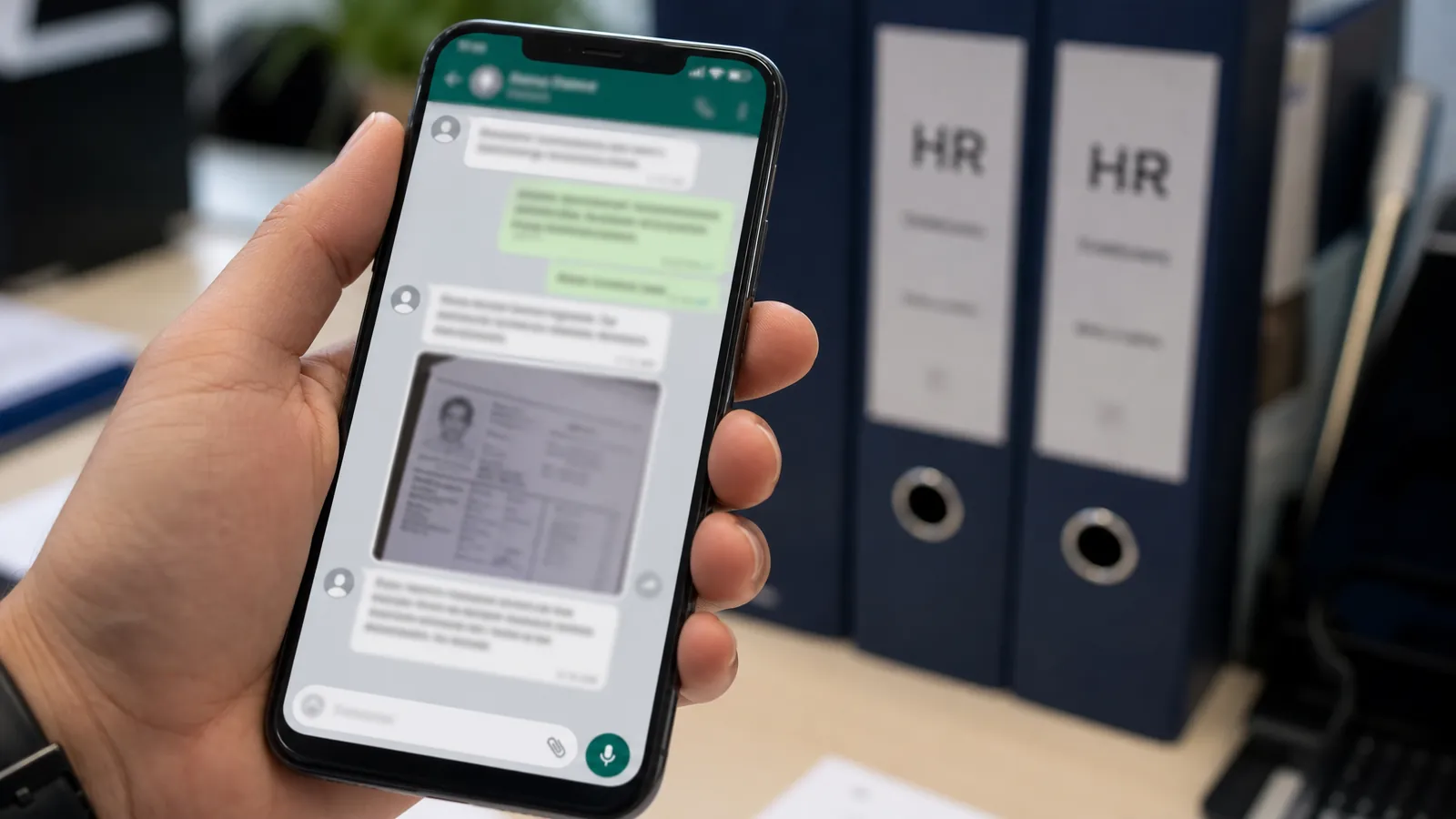
WhatsApp has become a default business communication tool for South African SMEs. Staff queries, leave requests, disciplinary discussions, HR decisions — all of it flows through personal devices on personal WhatsApp accounts, often through group chats that include managers, directors, and HR contacts. From a POPIA perspective, this is a significant unmanaged risk that most businesses have never formally considered.
WhatsApp messages containing employee personal information are processing events governed by the Act. WhatsApp data is unencrypted at rest on personal devices, with no deletion control and no audit trail.
WhatsApp routes data through servers outside South Africa, which creates a potential cross-border transfer obligation under POPIA Section 72 — an obligation that virtually no South African business using WhatsApp for HR communications has formally addressed. If a staff member’s personal device is lost, stolen, or replaced, and it contained a disciplinary discussion or a medical certificate forwarded via WhatsApp, that data is uncontrolled.
This is exactly the kind of gap that a managed IT partner can help close — not by banning WhatsApp, but by implementing business communication and document-sharing tools that keep HR data inside controlled, auditable systems rather than on personal devices. If your business is making HR decisions in WhatsApp groups, the first sign that this is a problem may be a complaint to the Information Regulator.
4. Treating Recruitment Data as Disposable — or Keeping It Forever
When a job is filled, most businesses either delete nothing (keeping every CV received) or delete everything immediately — including the documentation that would be needed if a hiring decision were challenged. Both positions create POPIA liability.
The correct approach: delete unsuccessful candidate data within 6 to 12 months unless explicit consent has been obtained to retain it for future opportunities. Data collected for a specific hiring process cannot be shared with other departments or used to build a future talent pool without fresh consent.
Common violations that businesses are committing right now include emailing CVs between managers without candidate consent, storing applicant data in unencrypted spreadsheets, keeping CV folders from candidates who applied years ago, and asking for ID numbers during the application process before a conditional offer has been made. None of these feel like significant compliance failures in the moment. All of them are.
5. Holding Onto HR Records Well Past Their Retention Date
POPIA’s Section 14 requires that records of personal information must not be retained longer than is necessary for the purpose for which they were collected — unless a specific law requires longer retention. For South African employers, the statutory minimums are clear: employment records must be kept for 3 years after the employment relationship ends under the Basic Conditions of Employment Act, and SARS payroll records must be kept for 5 years from the end of the relevant tax year.
Once those periods expire, the obligation does not lapse — it reverses. The employer must destroy or delete the records in a manner that prevents reconstruction. Holding payslips and banking details indefinitely, or maintaining long-departed employee records alongside active staff files, breaches the retention principle.
The practical problem most organisations discover when they conduct a records inventory for the first time: decade-old employee files on forgotten shared drives, former employee CVs in manager inboxes, legacy database exports that were never decommissioned. A retention policy that nobody enforces is not compliance — it is documentation of a violation that hasn’t been discovered yet.
What the Enforcement Environment Looks Like Right Now
The Information Regulator’s posture has moved from advisory to active. Between April 2024 and March 2025, organisations reported 2,374 security compromise incidents — an average of 198 per month. From April to November 2025, a further 1,947 breaches were reported, representing a 40% increase to 284 per month.
The Regulator’s own analysis found that 2,677 of 3,219 notifications in the 2025/2026 financial year were classified as non-cyber compromises — human error and organisational failures, not sophisticated ransomware attacks. The breaches in this space are misfiled documents, wrongly addressed emails, and uncontrolled shared drives.
Fines are now being confirmed by courts. The Blouberg Local Municipality case is the most directly relevant to employers: a former employee complained that their personal information had been published on the municipality’s website. The Regulator investigated, issued an enforcement notice, then an infringement notice with a R500,000 fine.
The municipality ignored both. The Regulator went to the Polokwane High Court, which confirmed the fine as a court order — the first time this mechanism has been used publicly under POPIA. The court reduced the fine to R250,000 (first offence, one affected data subject), but confirmed the principle: failing to protect a former employee’s data and then ignoring the Regulator leads to a confirmed court judgment.
According to IBM’s 2025 Cost of a Data Breach Report, the average cost of a data breach for South African organisations is R44.1 million — more than four times POPIA’s maximum administrative fine of R10 million. The leading cause of data breaches in SA in 2025 was third-party vendor and supply chain compromise, accounting for 17% of incidents. That is exactly the operator relationship gap — the missing payroll provider contract — that most SA businesses have not yet addressed.
The Regulator has stated publicly that its leniency is going to be a thing of the past. As of April 2025, CIPC has begun flagging non-compliant companies on BizPortal, making POPIA compliance status visible to clients, business partners, investors, and banks. The pattern in every confirmed enforcement action is consistent: organisations that engaged with the Regulator and fixed the problem — Dis-Chem, TransUnion — paid nothing.
Every fine has punished non-compliance with an enforcement notice, not the original lapse. The window for getting the basics right before an investigation arrives is closing.
What Getting Your POPIA HR Data in Order Actually Looks Like
The good news is that most of the high-risk gaps described in this article are fixable without a legal team or an enterprise-grade HR system.
The starting point is a records inventory — knowing exactly where your employee data lives, who has access to it, and how long you have been holding it. Most businesses have never done this. Most businesses are surprised by what they find when they do.
From there, the practical steps are: establish a written operator agreement with every third party that processes employee data on your behalf; implement role-based access controls so that payslips, performance files, and medical records are accessible only to those who need them; move HR communications off personal WhatsApp and onto business tools with audit trails and controlled access; set a retention schedule and enforce it; and register your Information Officer with the Information Regulator — it is free, it takes under 30 minutes, and it is the most-missed POPIA obligation in SA SMEs.
The March 2026 health information regulations have added a specific obligation to physically and digitally separate health data from general HR files. If your sick leave records, medical certificates, and occupational health reports are not in a restricted-access system separate from your general HR folder, that is a compliance gap you need to address now — there was no grace period.
A managed IT partner plays a practical role in closing most of these gaps. Role-based access controls, encrypted storage, access audit trails, secure deletion, and proper data governance across cloud and on-premise systems are IT problems as much as they are HR or legal problems. If your business does not have the infrastructure to enforce access controls on employee POPIA HR data, the policy documents and retention schedules you write will not protect you — because there is no technical layer making them real.
Conclusion
The most exposed data in many South African businesses is not in the customer database — it is in the HR folder. Payslips, leave records, performance files, medical certificates, and disciplinary records are all POPIA HR data, all highly sensitive, and for most SMEs, almost entirely unmanaged.
The Information Regulator is actively enforcing, courts are confirming fines, and the March 2026 health information regulations have added new obligations with no transitional period. The businesses that act now — before an investigation, not after — are the ones that fix the problem without paying for it.
Is Your HR Data Actually Protected?
If you are not confident about where your employee data lives, who has access to it, or whether your payroll provider has a written operator agreement in place, it is worth finding out before the Information Regulator does. Wired IT’s IT Strategy, Audit & Consultancy service helps South African businesses identify exactly these kinds of gaps — and close them before they become a compliance problem. Find out more about the Wired IT audit and consultancy service.
Or, if you would rather talk through your specific situation, get in touch directly. A conversation costs nothing, and a data breach costs far more than most businesses expect. Contact Wired IT here.