

Ransomware South Africa: 5 Cyber Threats Targeting SA Businesses Right Now — and How Wired IT Stops Them
If you’ve searched for “ransomware South Africa”, you’ve likely just read something worrying — an attack on a hospital, a port shut down, a business that paid millions to get its files back. What you probably haven’t found yet is a clear explanation of exactly what these threats are, why South African businesses are disproportionately exposed, and what you can actually do about it.
This article covers five cyber threats that are actively targeting SA businesses in 2026. For each one, we explain what it is in plain English, share a real South African example or statistic, and tell you exactly what Wired IT does to protect against it. No jargon. No padding. Just the information you need to make a good decision about your business.
Ransomware South Africa: The Threat That Locks Your Business Out

What it is
Ransomware is malicious software that encrypts your files and systems — making everything inaccessible — and then demands a payment to restore access. When it hits, your business can’t open a document, process an order, or access a customer record. It’s a digital padlock on everything you’ve built, and the criminals hold the key.
The South African picture
South Africa recorded 17,849 ransomware attacks in 2024 — the highest number on the African continent, according to the INTERPOL Africa Cyberthreat Assessment Report 2025. The scale of financial exposure has escalated sharply: the median ransom demand jumped from R2.8 million in 2024 to R17.5 million in 2025 — nearly a sixfold increase in one year, according to the Sophos State of Ransomware South Africa 2025 report. Even businesses that refuse to pay face an average recovery cost of R23 million, covering downtime, lost productivity, device repair, and reputational damage. Most concerning: 71% of SA organisations that were hit paid the ransom in 2025, up from 43% the year before — largely because only 35% had working backups to fall back on.
In June 2024, the BlackSuit ransomware group attacked the National Health Laboratory Service, deleting backups, encrypting systems, and stealing 1.2 terabytes of data. More than 6.3 million blood tests went unprocessed. The attack happened during an active mpox outbreak. The deleted backups meant there was no fallback — which is exactly why attackers target them first.
What Wired IT does
Wired IT’s approach to ransomware protection works on two levels: prevention and recovery. On the prevention side, we deploy endpoint detection tools that identify ransomware behaviour before encryption starts — most ransomware follows a recognisable pattern, and catching it early is the difference between a contained incident and a business shutdown.
On the recovery side, we implement and manage secure, tested backup systems — backups that are isolated from your main network so they can’t be deleted by the same attack. If the worst happens, your business gets back on its feet from a clean restore, not a ransom payment. This is part of our Business Continuity & Data Protection service, built specifically for the ransomware South Africa threat environment that SA businesses now face.
Infostealers: The Silent Credential Thief
What it is
An infostealer is malware that runs quietly in the background of an infected device, harvesting saved passwords, login credentials, browser cookies, and session tokens — then sends them to criminals without triggering any visible alert. You won’t know it’s happening. Your systems won’t slow down. There’s no ransom note. The stolen credentials are then sold on dark web markets or used directly to access your banking, email, cloud accounts, or business systems.
The South African picture
South Africa accounts for just under 35% of all infostealer incidents on the African continent — making it the single most targeted country for credential theft in Africa, according to the ESET Bi-Annual Threat Report 2025. Infostealer incidents in SA grew by 122% in the first half of 2025 alone, compared to the same period in 2024, with password stealers specifically up 116% year-on-year — both figures from Kaspersky. Globally, 3.2 billion credentials were stolen in 2024, 75% of which came from infostealer malware, according to Flashpoint research.
What makes infostealers particularly dangerous is that they can bypass multi-factor authentication. A criminal who captures an active session cookie — the token your browser holds after you’ve already logged in — can replay that session and access your account without needing your password or your one-time code. MFA is important, but it’s not enough on its own if the session itself has already been stolen.
What Wired IT does
Wired IT addresses infostealer attacks through credential monitoring and endpoint security as part of our Cybersecurity as a Service offering. We monitor for the behavioural signatures that infostealers leave behind — unusual data exfiltration patterns, unexpected outbound connections — and we include dark web monitoring to detect whether your business credentials have already been compromised and are circulating on criminal markets. If your login details are out there, we find them before someone uses them. Endpoint security ensures that devices connecting to your business network can’t be quietly harvested without detection. For SA businesses managing the infostealer SA businesses threat, early detection is everything.
Banking Trojans: When Your Online Banking is Compromised
What it is
A banking trojan is malware designed to intercept your online banking sessions — stealing login credentials, capturing one-time passwords, and in some cases redirecting transactions in real time. Unlike ransomware, you may not notice anything has happened until you check your bank statement. These trojans typically arrive via phishing emails or malicious downloads, embed themselves in your browser, and wait for you to log in.
The South African picture
Banking trojan incidents surged by 136% in South Africa in the first half of 2025 — the sharpest growth rate of any malware category tracked by Kaspersky in the country. SABRIC’s Annual Crime Statistics 2024 show digital banking fraud cases almost doubled, rising from 31,612 incidents in 2023 to 64,000 in 2024, with total digital fraud losses reaching R1.9 billion. Banking apps were the prime target, accounting for 65% of digital fraud cases.
One of the most active threats right now is the Grandoreiro banking trojan, which expanded to South Africa during tax season 2025. It spreads via convincing SARS-impersonation phishing emails — with subtle character substitutions in URLs to create fake SARS pages — then hijacks active banking sessions in real time. SARS has confirmed it will never request banking details by email or SMS, and will never send hyperlinks to other websites. If you’ve received an email asking you to click a link to access a SARS refund, it was not from SARS.
What Wired IT does
Wired IT protects against banking trojans through network monitoring and securing the environments where your financial transactions take place. We monitor for the unusual browser behaviour and outbound connections that banking trojans produce — patterns that a standard antivirus won’t necessarily catch. We also implement email filtering that intercepts SARS-impersonation and banking-impersonation emails before they reach your staff, and we run phishing simulations so your team knows what a convincing fake looks like before they encounter a real one.
Spyware: The Threat That Watches Without Making a Sound
What it is
Spyware monitors your activity without your knowledge. It can capture keystrokes — recording every password you type — take screenshots of your screen, record audio from your device’s microphone, or log the websites you visit. Unlike ransomware, it doesn’t disrupt anything. A business can be compromised for months before any visible sign appears, during which time competitors, fraudsters, or criminal organisations have a live view of your operations, communications, and financial activity.
The South African picture
Spyware is the fastest-growing malware category in South Africa. Kaspersky data shows a 117% year-on-year increase in spyware detections in 2025. In the first half of 2025 alone, spyware attacks occurred 3.6 times more frequently than in the same period of 2024 — a 264% increase. Sub-Saharan Africa recorded more than double the spyware attacks in H1 2025 compared to H1 2024, alongside a 64% increase in password stealer attacks. South Africa significantly outpaces the global spyware growth rate of 51%, meaning SA businesses are more exposed than the global average would suggest.
What Wired IT does
Detecting spyware requires behavioural monitoring — tools that watch for anomalies in how a device behaves rather than just scanning for known malware signatures. Spyware is specifically designed to evade signature-based detection, which is why most traditional antivirus products miss it. Wired IT deploys monitoring tools that flag unusual patterns: a device sending data at unexpected times, a process running in the background that shouldn’t be there, microphone access from an application that has no reason to use it. The goal is to catch spyware while it’s still gathering information — before anything leaves your business.
Phishing Attacks South Africa 2026: Still the Front Door for Every Threat
What it is
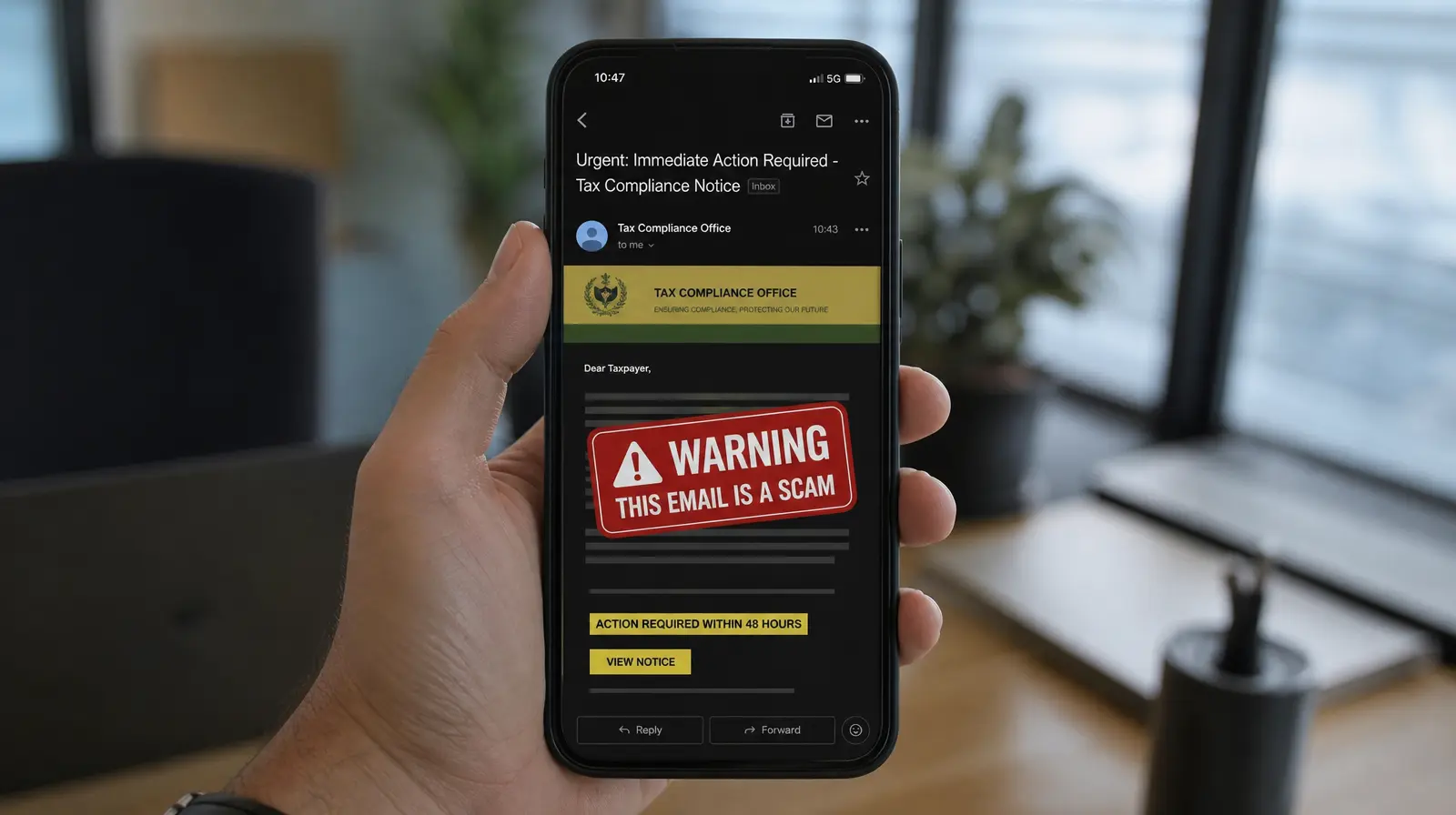
Phishing is a deceptive email — or SMS, or WhatsApp message — designed to look like it came from someone you trust: SARS, your bank, a supplier, a courier company. The message asks you to click a link, open an attachment, or provide information. If someone clicks, they may hand over login credentials, download malware, or authorise a fraudulent payment. Phishing is not a gateway to cybercrime — it is the front door. Most ransomware, banking trojans, and infostealers arrive through a phishing email.
The South African picture
Phishing accounts for 52% of all cyber threats in South Africa — nearly double the global average of 28% — leading ESET to describe South Africa as a ‘phishing capital of the cyber world’ in their mid-2025 threat report. In H2 2025, phishing still accounted for 45.7% of all detected cyber threats in SA, higher than the African average of 32.5%.
Check Point Research recorded 2,148 cyberattacks per organisation per week in South Africa in August 2025 — a 26% year-on-year increase — and in Africa, 80% of malicious files are delivered via email. More than four-fifths of South African adults have encountered a scam, averaging 258 scam encounters per person per year, according to GASA’s State of Scams in South Africa 2025 report.
The South African Weather Service attack in January 2025 illustrates the stakes clearly: attackers encrypted approximately 95% of the server environment and took the organisation’s website offline for nearly a month — entry was gained via a single phishing email, despite the organisation having existing cybersecurity protections in place. The phishing email was the front door. Once that door opened, the damage was significant.
What Wired IT does
Wired IT’s phishing protection works on three layers. The first is email filtering — intercepting suspicious emails before they reach an inbox. The second is simulated phishing: we send controlled, safe phishing tests to your staff so they can recognise a convincing fake without the real-world consequences. Research consistently shows that staff who have encountered a simulated phishing attempt are significantly less likely to fall for the real thing.
The third layer is staff awareness training, because SABRIC confirms that most digital banking fraud incidents in 2024 “were the result of social engineering techniques that exploited human error.” Technology alone doesn’t close this gap — people do, when they’re trained. Wired IT also tracks phishing attacks South Africa 2026 threat patterns to ensure defences stay current.
What All Five Threats Have in Common — and What That Means for Your Business
Every threat on this list shares the same root problem: a business without active, managed cybersecurity protection is running blind. Ransomware gets in through compromised credentials and phishing emails. Infostealers harvest those credentials silently. Banking trojans use phishing as their delivery mechanism. Spyware operates undetected for months. And phishing is the entry point for most of the above. These threats are not separate problems — they’re a connected chain.
The businesses that stay protected are the ones that treat cybersecurity as an ongoing operational function, not a once-off purchase. That means continuous monitoring, tested backups, email filtering, trained staff, and someone who knows what ‘normal’ looks like so they notice when it changes — which is exactly what our Wired Protect service is built to deliver.
Talk to Wired IT About Protecting Your Business
If any of the threats on this list concern you — and they should — the right next step is a conversation. Cybersecurity as a Service from Wired IT is designed specifically for South African SMEs that need real protection without the overhead of an in-house IT team. We handle the monitoring, the response, and the ongoing management — so you can focus on running your business.
Request a Cybersecurity Assessment
Or if you’d rather talk through your specific exposure first, get in touch with our team directly — we’ll give you a straight answer, not a sales pitch.